Brachytherapy is delivered by a team. A radiation oncologist prescribes and places the applicator or seeds, but the source, the dose plan, the machine and the patient's comfort are in the hands of medical physicists, dosimetrists, radiation therapists and nurses. Our guide to who performs brachytherapy explains what each one does. This guide answers the next question people ask: what do those jobs pay?
No official statistic exists for "brachytherapy" staff as such. What does exist is solid federal wage data for each profession in the United States, a large professional survey, published residency stipends and the national NHS pay scales in England. We read those sources on 23 November 2026 and report what they say, with links. Where a number is not public, we tell you that instead of filling the gap. Physician pay is covered separately in radiation oncologist salary.
The short answer
- Radiation therapist: US median $105,310 a year in May 2025 (Bureau of Labor Statistics).
- Medical dosimetrist: US median $147,470 a year in May 2025 (BLS).
- Medical physicist: the BLS has no separate line. Its median for all physicists was $172,250 in May 2025, and $239,240 for physicists working in private hospitals, the setting where clinical medical physicists are counted.
- Registered nurse: US median $97,550 in May 2025 (BLS). There is no official figure for oncology or brachytherapy nurses specifically.
- England (NHS): a newly qualified therapeutic radiographer starts on Band 5 at £32,073; a qualified clinical scientist in medical physics is typically Band 7, £49,387 to £56,515 (2026/27 scales).
- Brachytherapy premium: none of these sources reports different pay for staff who work in brachytherapy.
US pay at a glance
The Occupational Outlook Handbook from the BLS gives a median (the middle earner), plus the pay below which the lowest 10% fall and above which the highest 10% sit. All figures are annual wages for May 2025 and exclude the self-employed.
| Occupation (BLS category) | Lowest 10% earn less than | Median | Highest 10% earn more than | Jobs, 2025 | Typical entry education |
|---|---|---|---|---|---|
| Registered nurses | $68,940 | $97,550 | $137,470 | 3,465,400 | Not stated in our reading |
| Radiation therapists | $80,560 | $105,310 | $156,710 | 17,400 | Associate's degree |
| Medical dosimetrists | $111,670 | $147,470 | $185,450 | 3,500 | Bachelor's degree |
| Physicists (all fields) | $82,110 | $172,250 | $274,110 | About 23,200 | Doctoral or professional degree |
Two things to notice. The dosimetrist range is narrow and high: even the lowest tenth earn more than the median radiation therapist. And the physicist range is very wide, because the BLS category covers everyone from university researchers to hospital physicists. We come back to that below.
For scale, the BLS gave the average annual wage across all US occupations as $69,770 in May 2025. Every job on this page pays well above it.
Radiation therapist
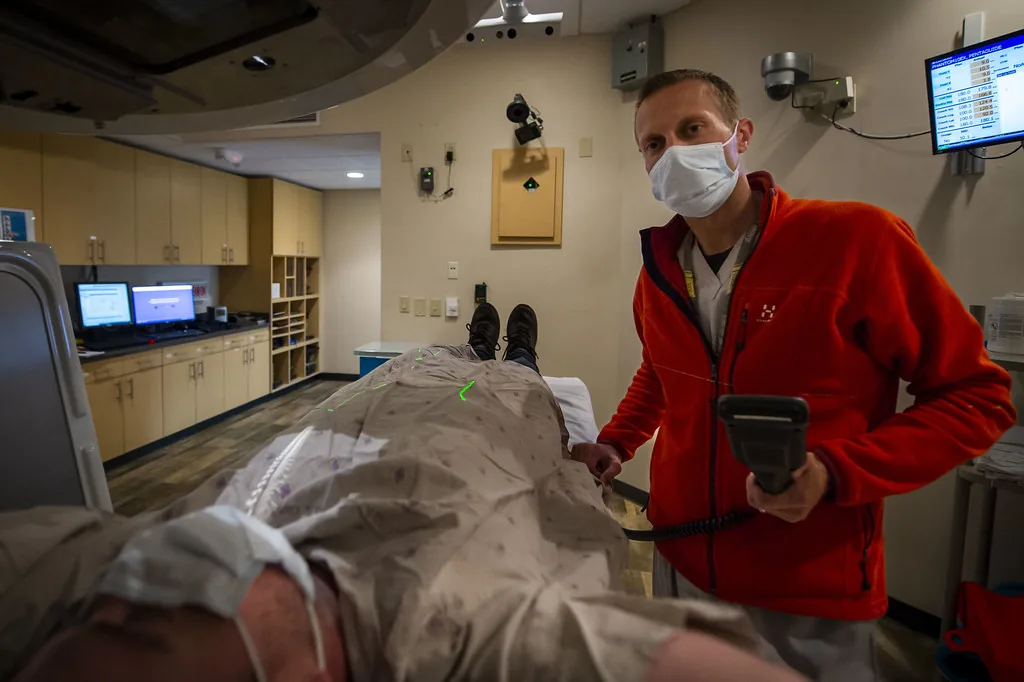
Radiation therapists (therapeutic radiographers in the UK) position patients and operate treatment machines. In brachytherapy they help set up and run the treatment alongside the physicist and the physician, and look after the patient while it is delivered.
The BLS median was $105,310 in May 2025, or $50.63 an hour. Where you work changes the figure noticeably:
| Industry (BLS, May 2025) | Median annual wage, radiation therapists |
|---|---|
| Outpatient care centers | $127,680 |
| Offices of physicians | $110,610 |
| Hospitals; state, local and private | $104,260 |
Outpatient centres paid a median $23,420 more than hospitals. The BLS does not explain the gap, and it does not say how many therapists in each setting work with brachytherapy.
Two other sources agree with the general level. A BLS feature published on 19 October 2026 gives a mean (average) wage of $114,990 for 17,070 employed radiation therapists in May 2025; means sit above medians when a minority earn a lot more. And the American Society of Radiologic Technologists (ASRT), in its 2024 Wage and Salary Survey of 19,687 respondents, reported mean compensation of $106,425 for radiation therapy, up 7.2% since 2022.
Looking back, the BLS median for radiation therapists was $98,300 in May 2023. The May 2025 figure is 7.1% higher, by our arithmetic.
Medical dosimetrist
The dosimetrist designs the dose plan. For brachytherapy that means working out where the source should dwell and for how long, or how many seeds to place and where, so the target gets the prescribed dose and nearby organs get as little as possible.
It is a small profession and a well-paid one. The BLS counts about 3,500 jobs and reports a median of $147,470 in May 2025, or $70.90 an hour. Unlike radiation therapy, pay barely differs between the two main settings:
| Industry (BLS, May 2025) | Median annual wage, medical dosimetrists |
|---|---|
| Offices of physicians | $148,190 |
| Hospitals; state, local and private | $147,010 |
| Educational services; state, local and private | $136,090 |
The BLS mean for May 2025 was $148,500 across 3,410 employed dosimetrists, almost identical to the median, which suggests pay is tightly clustered. The ASRT's 2024 survey put mean compensation for medical dosimetry at $136,510, the highest of the disciplines it reported.
Dosimetry pay has also risen quickly. The BLS median was $132,880 in May 2023; the May 2025 median is 11.0% higher, by our arithmetic.
The professional society, the American Association of Medical Dosimetrists (AAMD), runs its own salary survey. An ASTROnews article on the state of the profession, citing the 2023 AAMD survey, reported a 6% increase in fully remote dosimetrists compared with 2021. We have not seen the AAMD salary tables themselves and do not quote figures from them. The AAMD and its 2027 meeting are in our directory and events calendar.
Medical physicist
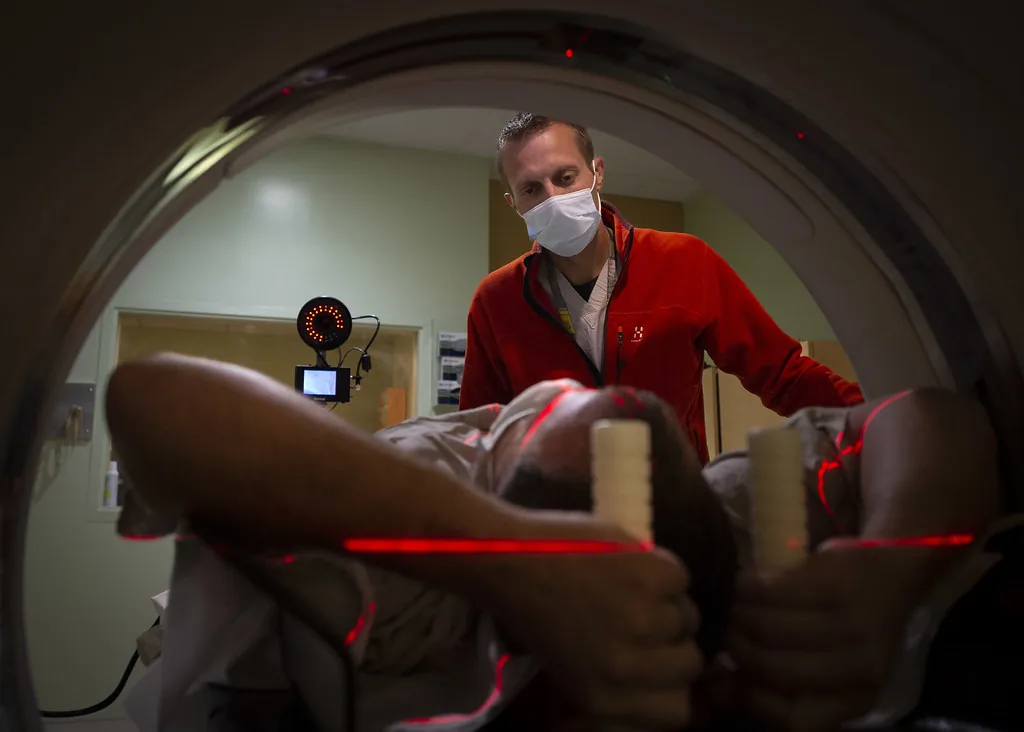
The medical physicist is responsible for the radioactive source, the afterloader, the quality checks and the independent verification of each plan. In US regulation the "authorized medical physicist" has a defined legal role in HDR treatments. It is the most highly qualified non-physician role on the team, and usually the best paid.
It is also the hardest to pin down from public data.
- The BLS has no "medical physicist" category. Medical physicists are counted with all physicists. That group had a median of $172,250 in May 2025, with the lowest 10% under $82,110 and the highest 10% over $274,110.
- The hospital figure is the closest proxy. The BLS reports a median of $239,240 for physicists employed in private hospitals, where 8% of all physicists work. That is far above physicists in research and development services ($176,170), the federal government ($146,900) or state universities ($84,600). It is a reasonable indicator for clinical physicists, but the BLS does not say that everyone in that row is a medical physicist.
- The profession's own survey is not public. The American Association of Physicists in Medicine (AAPM) lists an annual Professional Survey on its website, most recently for 2025. The report files sit in a protected area of the site, so we have not read them and do not reproduce their figures. Members can; if you are comparing an offer, that survey is the standard benchmark, broken down by degree, certification and experience.
Physics residency stipends
Before independent practice, most clinical physicists complete a two-year residency. Programmes publish their stipends, and they look like medical resident pay rather than physicist pay:
| Programme | Year 1 | Year 2 | Academic year |
|---|---|---|---|
| UT Southwestern, medical physics residency | $71,657 | $74,258 | 2026–2027 |
| University of Florida, medical physics residency | $67,177 | $69,444 | 2025–2026 |
| Mayo Clinic Arizona, medical physics residency | $75,105 | $77,121 | Not stated on the page |
These are three examples we could verify on the programmes' own pages, not a national average. UT Southwestern says its stipends follow the local hospital salary scale for medical residents. The AAPM and the residency accreditor CAMPEP are listed in our directory.
Oncology and brachytherapy nurses
Nurses, together with anaesthetists, look after the patient's comfort and safety before, during and after the procedure, which is why they feature in our guide to whether brachytherapy is painful.
The BLS does not publish pay by nursing specialty. For all registered nurses the median was $97,550 in May 2025, with the lowest 10% under $68,940 and the highest 10% over $137,470. Nurses in hospitals had a median of $100,220 and those in ambulatory healthcare services $91,230. We found no official figure for radiation oncology nurses, and none for nurses who work mainly in brachytherapy.
Is there extra pay for brachytherapy?
Not in any dataset we could find. The BLS classifies people by occupation, not by technique, and the ASRT figures we read are by discipline. So there is no verified answer to "how much does a brachytherapy physicist earn" or "brachytherapy radiation therapist salary" that differs from the profession-wide numbers above.
That does not mean the skill has no value. Brachytherapy is a small-volume, hands-on service and departments need staff who are trained and current in it; the regulatory roles are described in who performs brachytherapy, and the difference between HDR afterloading and permanent seeds in HDR vs LDR brachytherapy. Whether that is reflected in pay is a matter for each employer's grading or job description, and worth asking about directly.
What it costs to qualify
Salary is only half the sum. The other half is how long and how expensive it is to get there. Certification fees are the part that certifying bodies publish.
| Profession | Typical entry education (BLS) | Main US credential | Published fee |
|---|---|---|---|
| Radiation therapist | Associate's degree | ARRT certification in radiation therapy | $225 application fee, primary pathway (ARRT) |
| Medical dosimetrist | Bachelor's degree | CMD from the Medical Dosimetrist Certification Board | Not verified from MDCB directly; check its current handbook |
| Medical physicist | Doctoral or professional degree (BLS, all physicists) | ABR certification in medical physics | $250 application; Part 1 $210; Part 2 $640; Part 3 oral $780; then $205 a year (ABR) |
Paid once each, the ABR's medical physics fees add up to $1,880. The ABR and ARRT pages do not state an effective date for these fees; we read them on 23 November 2026. Tuition is the bigger cost and varies by school, so we do not give a figure. The certifying bodies (ARRT, MDCB, ABR) are linked in our directory, and the training routes for each profession are set out in brachytherapy training and fellowships.
One comparison is worth making. A dosimetrist typically enters with a bachelor's degree and a median wage of $147,470. A radiation therapist typically enters with an associate's degree and a median of $105,310. A physicist needs a graduate degree plus a two-year residency at around $67,000 to $77,000 a year before reaching hospital physicist pay. Years of training, not only the final salary, belong in the calculation.
United Kingdom: NHS pay bands
NHS staff other than doctors are paid on the Agenda for Change scale, where each job is assigned a band. The table shows the 2026/27 annual rates for England published by NHS Employers, effective from 1 April 2026, with the brachytherapy-team roles that the careers service Prospects maps to each band.
| Band | Entry | Top | Typical roles (per Prospects) |
|---|---|---|---|
| 5 | £32,073 | £39,043 | Newly qualified therapeutic radiographer |
| 6 | £39,959 | £48,117 | Experienced therapeutic radiographer; trainee clinical scientist (STP) |
| 7 | £49,387 | £56,515 | Advanced or specialist radiographer; qualified clinical scientist |
| 8a | £57,528 | £64,750 | Consultant radiographers and radiotherapy managers (8a to 8c); principal physicist |
| 8b | £66,582 | £77,368 | Senior radiographer managers; lead physicist |
| 8c | £79,504 | £91,609 | Top of the radiographer manager range; consultant clinical scientist |
| 8d | £94,356 | £108,814 | Most senior physics service leadership posts |
Staff in and around London receive a high-cost area supplement of 5% to 20%, and on-call and overtime are paid on top, according to Prospects. Scotland, Wales and Northern Ireland publish their own rates.
We did not find a separate national pay figure for dosimetrists in the UK sources we read, and we do not give one. If you are applying for a treatment planning post, ask which staff group and band it sits in. UK professional bodies, including the Society of Radiographers and IPEM, are in our directory.
Job outlook and shortages
| Occupation | Projected growth, 2025 to 2035 (BLS) | Openings per year |
|---|---|---|
| Radiation therapists | 3% | About 700 |
| Medical dosimetrists | 5% | About 200 |
| Physicists and astronomers | 7% | About 1,500 |
| Registered nurses | 6% | About 180,800 |
These are small professions. Two hundred dosimetry openings a year across the whole United States means that a handful of retirements in one region changes the local market.
Professional bodies describe pressure on supply. An ASTROnews feature on medical dosimetry reported a projected shortage of 50 dosimetrists a year by 2035, up from 10 a year in 2021, with retirements expected to peak between 2025 and 2030 and only 17 accredited training programmes. A companion feature on medical physics reported that about 2.2% of qualified medical physicists retire each year, that the retirement rate tripled between 1990–2000 and 2010–2020, and that there were more than 120 accredited therapy physics residency programmes. Both articles were published in 2024 and draw on earlier surveys, so treat them as background rather than current counts.
Shortage is one plausible reason dosimetry pay rose 11% in two years, but the BLS does not attribute the rise to any cause and neither do we.
How to compare a job offer
- Match the setting. For radiation therapists, compare with the BLS median for the same industry (outpatient centre, physician office or hospital), not the overall figure.
- Check median against mean. Job adverts and salary websites often quote averages. For therapists the BLS mean is about $9,700 above the median.
- Ask about call and brachytherapy cover. HDR treatments need a physicist present. Ask how often you will cover them, at how many sites, and whether call is paid.
- Ask what is funded. Certification fees, continuing education and conference travel add up. The meetings most relevant to each profession are in our events calendar.
- For physicists, use the AAPM survey. If you are a member, the Professional Survey is the benchmark employers expect you to know.
- In the NHS, ask for the band and the job description. The band fixes the pay range; the job description decides the band.
FAQ
How much does a medical dosimetrist make?
The US Bureau of Labor Statistics reports a median annual wage of $147,470 for medical dosimetrists in May 2025. The lowest 10% earned less than $111,670 and the highest 10% more than $185,450. It is a small profession of about 3,500 jobs.
How much does a radiation therapist make?
The BLS median for US radiation therapists was $105,310 in May 2025. Pay was higher in outpatient care centers, with a median of $127,680, than in hospitals, with a median of $104,260. The ASRT's 2024 survey reported mean compensation of $106,425.
What is a medical physicist's salary?
There is no official figure for medical physicists alone. The BLS counts them with all physicists, whose median was $172,250 in May 2025; physicists employed in private hospitals had a median of $239,240. The AAPM publishes a detailed annual Professional Survey, but its report is not public.
Do brachytherapy staff get paid more?
No dataset we found shows it. Official statistics classify staff by occupation, not by technique, so there are no verified figures for brachytherapy physicists, dosimetrists, therapists or nurses that differ from the profession-wide numbers. Any premium is down to an employer's own grading.
How much do therapeutic radiographers and radiotherapy physicists earn in the NHS?
On the 2026/27 Agenda for Change scale in England, a newly qualified therapeutic radiographer starts on Band 5 at £32,073 and experienced radiographers are on Band 6, £39,959 to £48,117. A qualified clinical scientist in medical physics is typically Band 7, £49,387 to £56,515, with senior posts in Bands 8a to 8d.
Which radiation therapy job pays the most without a medical degree?
On BLS medians for May 2025, hospital physicists come first ($239,240 for physicists in private hospitals), followed by medical dosimetrists ($147,470) and radiation therapists ($105,310). Physicists typically need a doctoral or professional degree and a two-year residency, so the training is also the longest.
Sources
- US Bureau of Labor Statistics — Occupational Outlook Handbook: Radiation Therapists (May 2025 wages; 2025–35 outlook) (accessed 23 November 2026)
- US Bureau of Labor Statistics — Occupational Outlook Handbook: Medical Dosimetrists (May 2025 wages; 2025–35 outlook) (accessed 23 November 2026)
- US Bureau of Labor Statistics — Occupational Outlook Handbook: Physicists and Astronomers (May 2025 wages by industry) (accessed 23 November 2026)
- US Bureau of Labor Statistics — Occupational Outlook Handbook: Registered Nurses (May 2025 wages) (accessed 23 November 2026)
- US Bureau of Labor Statistics — The Economics Daily: Recognizing nuclear science occupations for Nuclear Science Week (mean wages, May 2025; 19 October 2026) (accessed 23 November 2026)
- US Bureau of Labor Statistics — Occupational Employment and Wages, May 2023: Radiation Therapists (accessed 23 November 2026)
- US Bureau of Labor Statistics — Occupational Employment and Wages, May 2023: Medical Dosimetrists (accessed 23 November 2026)
- ASRT — Wage and Salary Survey shows wage increases across all major disciplines (31 October 2024) (accessed 23 November 2026)
- AAPM — Surveys (list of annual Professional Survey reports) (accessed 23 November 2026)
- UT Southwestern — Medical Physics Residency: Salary and Benefits (2026–2027) (accessed 23 November 2026)
- University of Florida — Medical Physics Residency: Salary and Benefits (2025–2026) (accessed 23 November 2026)
- Mayo Clinic College of Medicine and Science — Medical Physics Residency (Arizona): Stipend and Benefits (accessed 23 November 2026)
- ARRT — Application Fees (accessed 23 November 2026)
- American Board of Radiology — Initial Certification Fees and Payments (accessed 23 November 2026)
- American Board of Radiology — Annual Continuing Certification Fees (accessed 23 November 2026)
- NHS Employers — Pay scales for 2026/27 (Agenda for Change, England) (accessed 23 November 2026)
- Prospects — Job profile: Therapeutic radiographer (salary by band) (accessed 23 November 2026)
- Prospects — Job profile: Clinical scientist, medical physics (salary by band) (accessed 23 November 2026)
- ASTROnews, Summer 2024 — The state of medical dosimetry (accessed 23 November 2026)
- ASTROnews, Summer 2024 — The medical physics workforce (accessed 23 November 2026)
Educational content, not financial or career advice. Wage statistics are national figures for the dates shown and official pay scales change every year; check the linked sources and the terms of any job offer. Written by the brachytherapist.com editorial team from the sources listed above.